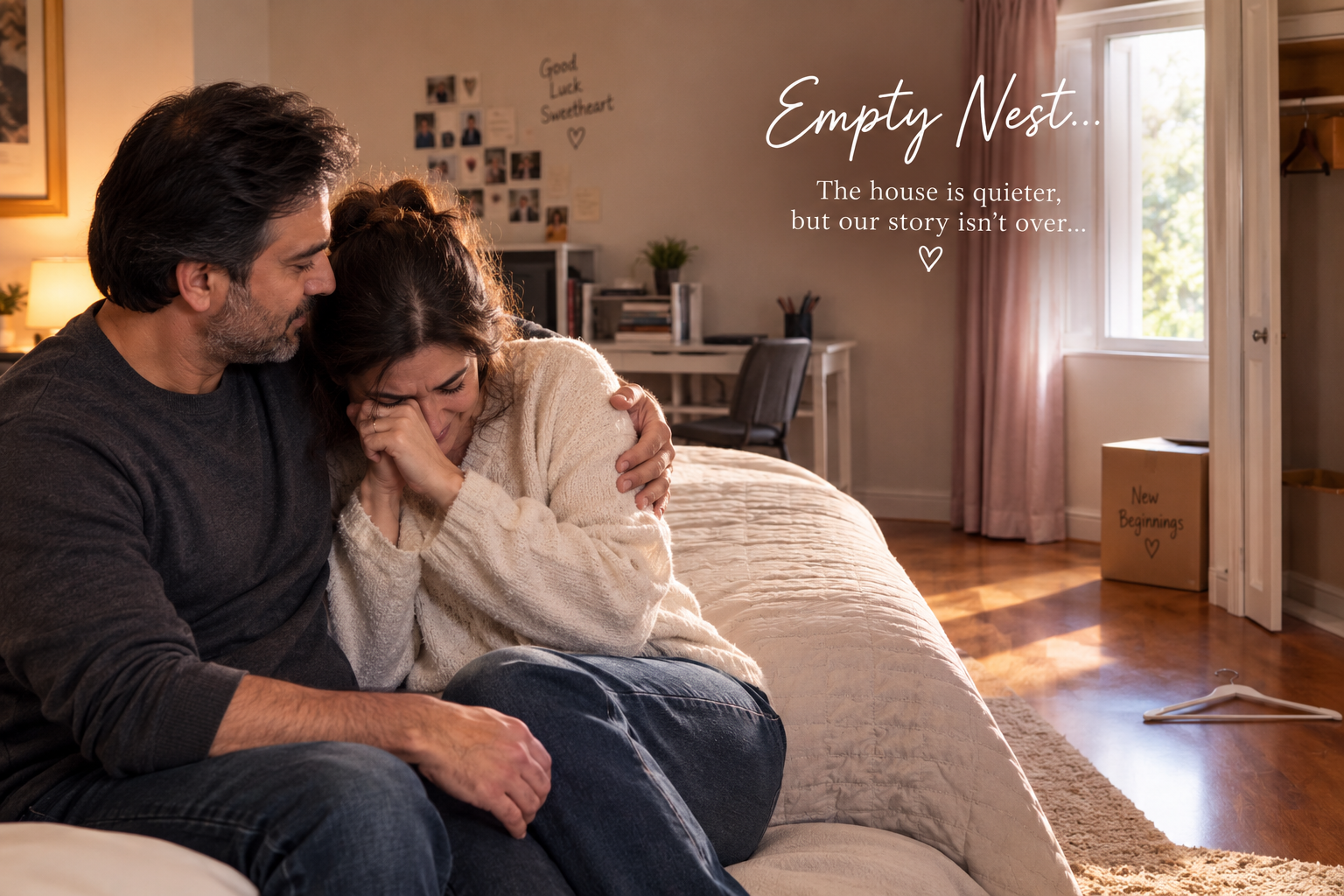
This notebook is fiction. The family in it is invented, but plenty of real couples will know the feeling.
Our daughter got a job in Multan, a few hours' drive from here, and today she left. I helped pack the boxes. I hugged her at the door and told her I was proud, and I meant it. Then I walked back inside and stood in her room for far longer than makes sense.
The bed is still there. So is the desk. The wardrobe is empty except for one hanger lying on the floor that neither of us picked up before she went. I have decided to leave it where it is.
Twenty-two years of school runs and packed lunches, and midnight phone calls when she couldn't sleep before an exam, and now it is simply over. One Tuesday. I sat on her bed and cried the ugly way, nose running, hardly able to breathe. Farhan found me about ten minutes later. He didn't say much. He sat down and put his arm around me.
“Quiet in here,” was all he said.
“Yes,” I said, laughing and crying at once. “Too quiet.”
Goodbyes like this come in many sizes. Some children move a few hours away. Plenty of families watch a son or daughter settle in the UK or Canada, where the distance is far greater and visits are rare. The sadness is real in both cases.
This week I woke up and started making breakfast for three out of pure habit, and remembered halfway through the first egg. I come home expecting to hear her music from upstairs, and there is nothing. I have been cooking far too much food for two weeks and throwing half of it away.
Farhan is handling it completely differently, which annoyed me more than I would like to admit. He comes home, makes tea, sits in his chair with a book as if nothing has happened. Tonight I finally asked him how he could be so fine about it.
He put the book down. “I'm not fine,” he said. “I'm just bad at talking about it.”
Now that I think about it, he has been eating less. He is not sleeping well and he spends a lot more time in the garage than he used to. He is grieving too. It just doesn't look like grieving on him.
We have been avoiding each other without meaning to. It is strange how, after so many years of being “mum and dad”, you forget how to be two people eating dinner. When the children were small we talked about the children. When they grew up, we still mostly talked about the children. Take them away and what is left is a silence where the conversation used to be.
Last night I looked at him across the table and thought, who is this man? Are we still the two people who got married at twenty-four? Do we actually like each other, or did we just get used to each other, which is not the same thing at all?
At about three in the morning I woke up and he was awake too, staring at the ceiling fan.
“You up?”
“Can't sleep.”
“Me neither.”
We lay there for a while without talking. Then, and I hadn't planned to, I asked, “Are we going to be okay?”
He took my hand and took his time answering. “Yes. I think we just have to work out who we are again.”
Some silences have feelings tucked underneath them. We wrote about one of those in Crying Alone in Marriage, and about the everyday habits that help couples find the words in our guide to building a lasting marriage.
That 3 a.m. conversation started something. We began going out on proper dates, not dinner in front of the television. We take walks and actually talk. We sit in cafes and ask each other questions like two strangers getting acquainted, which, if I am honest, is partly what we are.
I asked Farhan what he wanted to do with the rest of his life and he blinked at me. “I've never thought about it,” he said. “For twenty-five years I was thinking about the kids.”
“Same. I've been wondering about volunteering somewhere. With animals, maybe. I always liked animals.”
“Did you? I didn't know that.”
“Twenty-six years married and we're still finding things out.”
We laughed. I realised we had not laughed much in weeks.
There were harder conversations too. I told him I was scared we had nothing in common without the children holding us together. He said he was afraid of becoming irrelevant, of just killing time for the next twenty years, and that I might want something different one day. Neither of us had known the other was afraid of almost exactly the same thing.
“I don't want to lose you,” I told him.
“I'm not going anywhere. We'll work out what's next.”
“What is next, though?”
He smiled. “No idea. But together.”
It has taken months, not weeks, to find a rhythm. We try things we never had time for: weekend trips with no plan, dinner out on a Wednesday for no reason at all, staying up late talking when we would once have been asleep by ten.
Last Saturday I woke up and found him already dressed. “Get up, we're going somewhere,” he said, and refused to say where. We drove for hours to the town where we spent our honeymoon. We wandered around, looked in a few shops and ate a very ordinary lunch. It was silly and unplanned, and one of the best days I have had in a long time.
Many marriages in Pakistan begin with a family introduction, which means a lot of couples spend the early years learning about each other and the later years learning about each other all over again. Both stages are normal.
Underneath the dates and the trips there was something else we had to face. For years our whole identity had been wrapped up in being parents, and when that stopped being the main job there was just a gap where it used to be.
So I started a garden, something I have wanted to do forever and never had time for. Farhan took up woodworking. He has always been good with his hands but never did anything with it. They are small things, but they matter, because they are only mine and only his, and not filtered through anyone else.
Nobody warned me I would grieve the actual rooms. Or that I would look at my husband of decades and for a moment think, who is this? Or that I would have to get to know him again and, in a way, fall for him again from nothing, this late into the marriage.
But it is not only hard, and that is what I did not expect. I have learned things about Farhan this year that I did not know in twenty-six years. I appreciate him more, probably because I am paying attention again instead of running on autopilot.
Last week I stood in her room for a minute. Bare walls, empty wardrobe, that one hanger still on the floor. I smiled a little. It was still a bit sad, but a real smile. That room is part of our story. The story is not finished. It is just a different chapter now, with just the two of us figuring out the rest.
What I would tell anyone about to go through this
It is fine to be sad. It does not mean the marriage is broken. Give yourself time, and give your partner time too, because he or she may process it completely differently. Keep talking even when it is awkward. Do not assume you already know everything about someone you have been married to for decades. People change quietly, and you can miss it if you stop looking.
The person you married is probably still in there, under all the quiet. It may take a bit of digging to find them, but usually they are there. And the empty house is not only sad. After the first shock it becomes time, and quiet, and a different kind of love: slower, and built out of actually knowing someone for twenty years. There are still days I miss the noise. But there are plenty of others when I look at him across the table and think, yes. Still him. Still my pick.
If the low mood does not lift, or it starts affecting your sleep and appetite, it is worth speaking to a doctor. Mind, a mental health charity in the UK, publishes clear everyday information on looking after your wellbeing.
And if you want to know what the years after this chapter might look like, we wrote about that too, in Growing Old Together.
If you are not married yet and wondering what a lifetime of companionship might look like, learn about us or talk to our team.