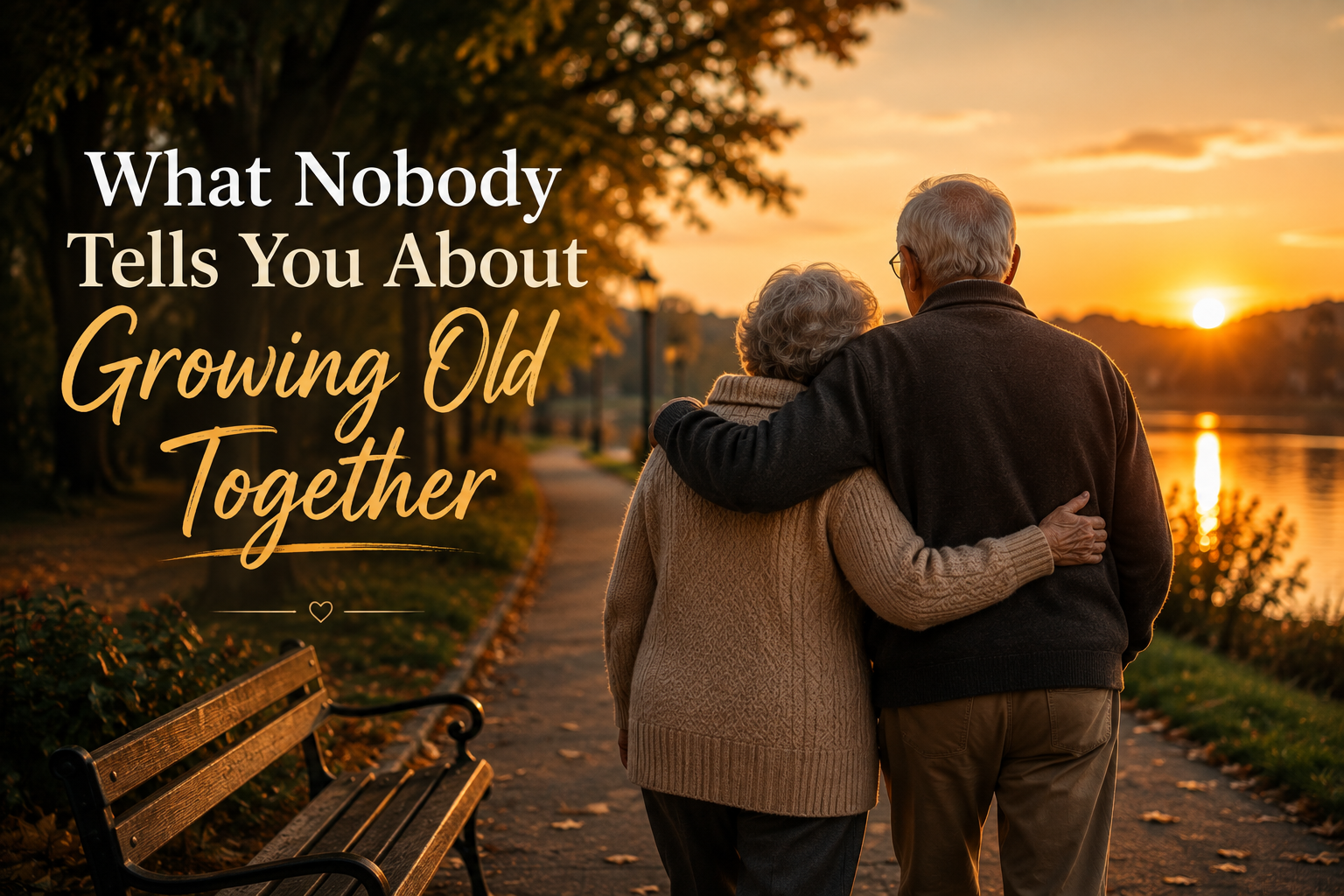
I noticed a new wrinkle by my eye on a Tuesday, brushing my teeth, half asleep, the light hitting my face at some weird angle. Stood there a minute just looking at it. Then at breakfast I actually looked at my husband instead of just seeing him — his hairline's gone back more than I'd registered, and he winced getting up from the chair, which he does most mornings now, though he'd deny his back bothers him if you asked directly.
We're both getting old at roughly the same rate and I hadn't really sat with that until this random Tuesday. Nobody warns you about this side of marriage. Everyone talks about the wedding, the newborn stuff, buying a house. Nobody mentions what it's like watching someone age while you're aging next to them, at close range, on the same clock.
My sister just said "welcome to the club" when I mentioned it on the phone, in this tired voice, like she'd already been through it. She's four years older. I didn't ask what else was on the list. Wasn't ready.
💭 The first truth: Nobody warns you about watching someone age while you're aging next to them, at close range, on the same clock. It's strange and real and nobody talks about it.
I went and looked at old photos after that call, which probably wasn't a great idea. Found one from our honeymoon, both of us squinting into the sun on some beach in a town I can't even remember the name of anymore. I looked so young it was almost funny. Not sad exactly, just strange, like looking at a stranger who happens to share my face.
Bodies Change, That's Just the Deal
Bodies change, that's just the deal. Mine barely resembles the one I had when I got married — I used to eat whatever without thinking, had energy past midnight, none of that really applies anymore. My husband's version of it is his back and the afternoon naps he used to make fun of me for. We don't talk about any of this much, honestly. Feels too exposed. A few years ago I got weirdly self-conscious undressing in front of him after two decades together, which is a ridiculous thing to admit, but there it is. Asked him once if it bothered him that I'd changed so much. He looked confused, like I'd asked something in another language, and said "you're just you, what are you talking about." I don't think he was being nice about it. I think it genuinely hadn't occurred to him to keep score.
👀 The truth about bodies: Your partner isn't keeping score. When you ask if your changes bother them, they look confused — because they see you, not a list of things that have changed.
Health Scares and the Waiting Rooms
Then there's the health stuff. Somewhere in your forties or fifties it starts — a test result you don't want to look up, a lump, a pain that sticks around longer than it should. I remember exactly where I was sitting the first time it happened with my husband. Something routine turned into "we need more tests," and I sat in that waiting room pretending to read a magazine while doing math in my head about how many years we'd had versus how many we might have left, hating myself the whole time for doing it. Turned out fine. Nothing. But we stopped brushing past each other in the mornings without saying good morning properly after that, for a while at least. There was another scare two years later, his heart this time, and by then we already knew the drill — the waiting room, both of you pretending to be calm for the other one's sake. You don't get used to it. You just get better at hiding how scared you are.
A friend of mine who lost her husband with zero warning told me once that the scares are almost a kind of mercy, because they make you say things you'd otherwise put off indefinitely. I think about that more than I want to.
My husband handles it differently than I do. He goes quiet for a day or two after any kind of bad news from a doctor, doesn't want to talk it through the way I do, just needs to sit with it alone for a bit. Took me years to stop taking that personally. I used to think his silence meant he wasn't scared, or worse, that he didn't care as much as I did. Turns out it just meant he processes things on a different timeline than I do.
❤️ The truth about health scares: You don't get used to them. You just get better at hiding how scared you are. And your partner processes it differently — silence isn't indifference, it's just a different timeline.
Losing Parents, Losing Friends
The parents thing is its own category. Nobody tells you before the wedding that eventually your in-laws get old and frail and you're the one making phone calls to their doctors. My mother-in-law's decline felt slow and sudden at the same time — small stuff first, misplacing keys, then a fall that put her in the hospital. Watching her fade was hard. Watching my husband lose his mother in slow motion while she was still around to lose was somehow worse to be near. I couldn't fix any of it. I made the calls he couldn't bring himself to make, sat next to him when there was nothing left to say. One night after a bad visit he sat on the edge of our bed and cried without a word and I just sat there, didn't try to fix it. Probably the most useful thing I did all year.
She died on a Tuesday, actually, which is a stupid detail to fixate on but I do. He didn't cry at the funeral. Cried three weeks later over a jar of strawberry jam we found in the pantry, the kind she used to make. Grief doesn't run on any schedule I've ever been able to predict.
Her house sat empty for almost a year before we could deal with clearing it out. When we finally did, we found decades of birthday cards she'd kept, every single one, in a shoebox under her bed. My husband sat on the floor of that closet reading through them for probably two hours while I packed boxes around him. I didn't rush him. Some things just take as long as they take.
Friends thin out too, and nobody talks about that part much, maybe because it's embarrassing to admit how lonely it gets. People move, get busy with their own aging parents, their own health. Some die. The group you used to see weekly turns into a holiday card, if that. Puts weird pressure on a marriage — suddenly one person is carrying support that used to be spread across five or six people. We joined a walking group last year mostly out of desperation for something resembling a social life. Half the group is widowed, which surprised me and which I think about more than I'd like to. One woman, Rosa, talks about her late husband so easily it took me a while to realize he'd died less than a year ago. Asked her about it once and she just shrugged, said you learn to carry it without making everyone else carry it too.
Retirement and the New Rhythm
Retirement changed the shape of our whole day. My husband retired two years before me and suddenly the house had a different rhythm — him wandering in asking what's for lunch at eleven in the morning like it's a real mystery. I loved him and also wanted to strangle him a little that first month. Arguments about nothing, which were really about space and who was interrupting whose day. A friend laughed when I complained and said her own adjustment took nearly a year before it stopped feeling like a hostile takeover of her house. Made me feel less bad about how much I resented it. We found some rhythm eventually — separate corners of the house, evening walks, a garden neither of us particularly needed but started anyway because we didn't know what else to do with the extra hours.
🏡 The truth about retirement: It changes the whole rhythm of your house. Arguments about nothing are really about space. It takes time to find a new rhythm — separate corners, evening walks, something to do with the extra hours.
Independence, Piece by Piece
Independence goes slowly, piece by piece. Driving at night gets harder. Groceries turn into two trips instead of one. My father was fiercely independent, wouldn't accept help changing a lightbulb into his seventies, and when his body finally forced the issue it broke something in him — I could see it on his face every single time he had to ask. Moved in with my sister the last two years of his life, fought it for months before agreeing, mostly out of exhaustion rather than any real change of heart. He never fully stopped apologizing when someone helped him with something. My husband reminds me to take my blood pressure medication now, which used to annoy me and now mostly doesn't. Not him treating me like I can't manage things. Just him paying attention, I think.
Funny enough, I do the same thing to him now without really noticing until he points it out. I've started laying his pills out on the counter every morning, and last week he said, half joking, that between the two of us we probably have enough combined memory left to run one functional adult. I laughed, but it stuck with me a little longer than it should have.
The Archive of Years
The good part, if there's one clean good part, is the memory. All the years build a private archive nobody else has access to. Our first apartment had a kitchen so small we could barely both stand in it, I burned more dinners than I want to admit, he pretended every one was fine. Road trips because plane tickets weren't in the budget. Nights on a secondhand couch talking about nothing until two in the morning. Found an old box of photos from that apartment last winter, edges curling, colors gone yellow. Spent a whole afternoon going through them, arguing about which year a photo was from. Random Sunday, nothing special about the day itself, still one of my favorite afternoons in years.
There's a comfort in being known, too, flaws and all. After this long he knows my moods before I've noticed them myself — which silence means I'm fine and which one means something's actually wrong. Nothing left to perform. Our daughter's in a new relationship and constantly anxious about showing the "right" version of herself, and I remember that feeling well enough. Don't miss it.
📖 The truth about the archive: All the years build a private archive nobody else has access to. The shared history, the inside jokes, the comfort of being known completely — that's the part that makes it all worth it.
The Fear That Doesn't Go Away
Underneath all of it there's a fear that doesn't go away — that the time isn't unlimited, that one of us ends up the one left behind. Some nights I lie there listening to him breathe, doing the math on how many nights like this are actually left. Used to push the thought away completely. Now I let it sit a minute, then come back to what's true right now — the coffee, the conversation, his hand in the dark without needing to look for it. Brought it up with him once at two in the morning, half asleep, probably not making sense. He said he thinks about it too, just hadn't said it out loud, figured one of us should eventually. We didn't solve anything. Just lay there a while longer, not talking, which was somehow enough.
It's hard, most of it. You lose parents, friends, versions of yourself you didn't know you'd miss until they were gone. Nobody prepares you for most of that going in. But it's also better than I expected at twenty-five — the shared history nobody else can claim, being known without hiding, the small forgettable stuff, coffee handed across a table, a joke from thirty years ago that still lands for reasons nobody outside the marriage would get. None of it happens if you don't stay.
If you're in the middle of some version of this right now — it's fine to be scared, fine to grieve people already gone and dread the ones you haven't lost yet. Doesn't make you weak, just means you're paying attention. Try not to let the fear crowd out what's actually in front of you today. Look at the person next to you. It's hard, and it's still one of the better things I've done with my life.
💍 Final thought: It's hard — losing parents, friends, versions of yourself. But it's also better than you expected. The shared history, being known without hiding, the small forgettable stuff. None of it happens if you don't stay. Look at the person next to you. It's hard, and it's still one of the better things you can do with your life.