Okay, confession. For the first five years of my marriage I secretly thought my husband didn't actually like me. Loved me, sure, I never doubted that part. But liked me — wanted to be around me the way he wanted to be around his friends — that felt like a totally separate, much less guaranteed thing.
He'd be on the phone with the guys he's known since college and laughing in this way I swear I'd never once heard directed at me. He'd talk about fishing (I have never once cared about fishing, still don't) and get more animated than he did about our actual life together. And then I'd catch him checking his phone while I was mid-sentence telling him something and just think, well, he's bored of me, that's it, that's the marriage now.
Never said any of it out loud. Felt too raw. Too much like I was asking for reassurance I should've been able to give myself. So I just sat on it for years, and it turned into this dull ache I couldn't have even explained properly if you'd asked.
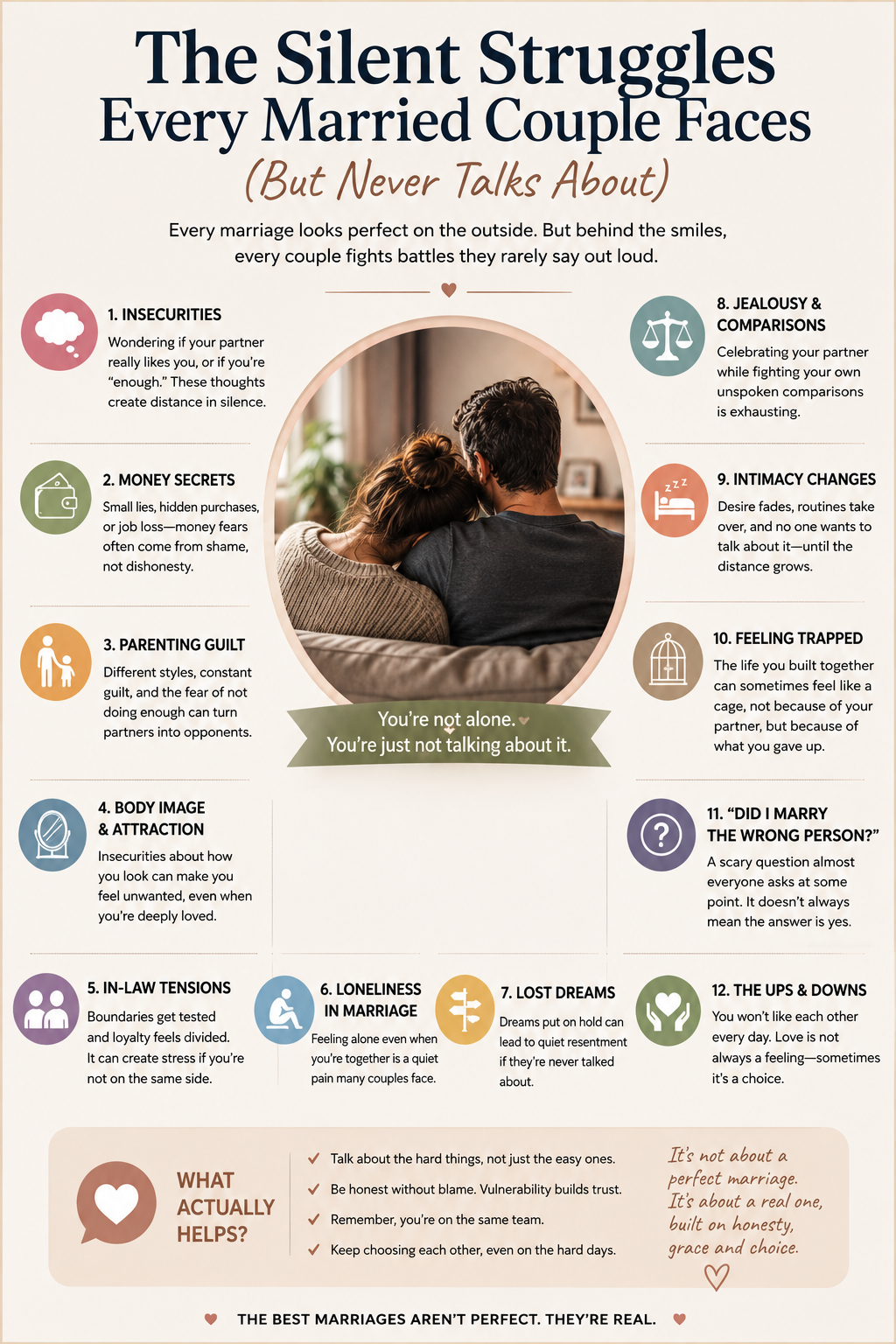
💭 The first truth: Most of us are secretly convinced our partner is disappointed in us. We spend years scared of something that was never actually true.
Turns out he had his own version running in the background the whole time. He told me years later — years — that he'd spent most of that stretch quietly convinced he wasn't good enough for me, that eventually I'd wake up and realize I'd settled and go find someone better matched. Watching me do well at things made him proud, he said, but there was this thread of dread woven into the pride too. Like my doing well was a countdown to him losing me.
So there we were. Same bed most nights. Both of us privately convinced the other one was a little disappointed in us. When it finally came out — not planned, it just spilled out mid-argument about something completely unrelated, I don't even remember what — we ended up laughing. Not because any of it was funny. More because we'd spent years scared of something that was never actually true.
That was the crack that let everything else out, honestly.

The Money Secrets Nobody Admits
Money's probably the thing couples lie about the most, and it's rarely a big dramatic lie. Small stuff. A woman I know bought a handbag she couldn't really afford and hid it in the back of her closet for six months before her husband found the charge on the statement. Wasn't greed, not really — embarrassment. Embarrassed she wanted something she didn't need, embarrassed her spending had gotten a little away from her, embarrassed enough that hiding felt easier than saying it.
I also know a guy who lost his job and kept "going to work" for three weeks. Left at the usual time, came back at the usual time, spent his days at a coffee shop with his resume open, coffee going cold. He said he couldn't stand the idea of watching fear show up on his wife's face. Couldn't stand feeling like a failure in front of her.
That kind of secret doesn't just sit there quietly, though. It corrodes things. And the hard part is never the money itself, it's the sentence "I messed up, please don't be mad" — which is genuinely one of the hardest things to say to the one person whose opinion of you actually matters. But that sentence tends to be the thing that saves it. Most money fights, once you actually dig into them, aren't about money at all. They're about whether you still trust the other person to catch you when you slip.
💰 The truth about money: Most money fights aren't about money. They're about trust, shame, and whether you still trust your partner to catch you when you slip.
Parenting Guilt and Coping in Opposite Directions
Parenting guilt is its own mess. It's this low static running underneath everything — not patient enough, not present enough, not doing enough of whatever the internet says you should be doing. And nobody warns you that you and your partner will cope with that guilt in completely different, sometimes maddening ways. One of you throws yourself all the way in, reads every book, shows up to every practice. The other pulls back, needs space, needs an actual break and doesn't always explain why.
From where I stood I thought my husband just didn't care as much as I did. He told me later he thought I was making an already hard job harder than it needed to be. Neither of us was right, obviously. We were just scared in opposite directions. What actually helped wasn't figuring out who was "coping correctly" — it was just saying out loud that we were both struggling, differently, and neither of us was doing it wrong.
The Body Image Fear Nobody Says Out Loud
Our bodies change and basically nobody admits how scary that is inside a marriage. Weight, hair, the kind of tired that doesn't sleep off anymore. And under all that there's this quieter fear that your partner's eventually going to look at you and see someone he's settling for.
I know a woman who stopped letting her husband see her fully undressed. Not because she didn't trust him — because she'd stopped trusting the mirror. He didn't clock it for a while, everyone's busy, but eventually he did, and it genuinely hurt him. Not because of anything about her body. Because it meant she'd quietly stopped believing something he'd been telling her the whole time. He tried to reassure her. She couldn't take it in, because she didn't believe it about herself first.
I think about that one a lot, honestly. Your partner mostly isn't looking at you the way you look at yourself under bad bathroom lighting at eleven at night. They're looking at someone they've chosen, actively, again and again, through every version of your body that's shown up along the way.
👀 The truth about body image: Your partner isn't looking at you the way you look at yourself. They're looking at someone they've chosen, actively, again and again, through every version of you.
In-Laws, Jealousy, and the Loneliness
In-laws, god. Sometimes you just don't love them. "Tolerate" is doing a lot of heavy lifting in that sentence some days. You can't really say "your mother makes me want to leave the room" without it becoming a whole thing, so you smile, you get through dinner, and then you vent to a friend later or let it turn into small passive-aggressive comments your partner doesn't even understand the source of.
What actually helps is saying the true thing directly, without it becoming an ultimatum. My husband's sister has a way of talking to me that makes my jaw lock up every single time, and for a long while I just absorbed it because I didn't want to seem like I was attacking his family. When I finally told him, he laughed and said "I know, she's been doing that to me for thirty years, I've just had more practice." We made an actual plan after that — shorter visits, sticking together at gatherings, permission to leave early. Didn't fix his sister. Made the whole thing bearable, because we were finally on the same side of it.
There's a loneliness that's specific to marriage and it's a weird one — being in the same room as someone and still feeling completely by yourself. Not because they're ignoring you. Sometimes they're right there and it still doesn't reach you. Worse in some ways than being actually single, because you're supposed to have someone, technically you do, and somehow it still isn't closing the gap.
Nobody talks about this much because saying it out loud feels disloyal, like you're confessing something shameful about the marriage. But naming it plainly — I feel far away from you and I don't know why — without turning it into blame, seems to be most of what actually closes the distance.
The Dreams We Quietly Shelve
And then there's the dreams that quietly got shelved somewhere along the way. The trip before the mortgage. The art before the desk job. The city apartment before the suburbs because the schools were better out here. Nobody says these out loud because they feel selfish, like you're admitting you wanted a life outside the one you built together.
But they don't go anywhere. They show up in the fifteen minutes before you fall asleep. In the what-if thoughts you don't say out loud. And sometimes, unfairly, you end up resenting your partner a little for representing the life you picked instead, even though they didn't take anything from you, even though you both chose this, together, for reasons that made sense at the time.
I wanted to write a book for probably a decade before I said so out loud. Buried it because it felt impossible to fit in — no time, no energy left over, no real support for it. When I finally told my husband he looked genuinely surprised. "You never said anything. I would've helped." And he did. Took the kids most weekends for a while, kept asking how the pages were going even when I didn't want to answer. Finished it eventually. Didn't sell much. But it existed, and saying the dream out loud is what made it possible, not some private willpower I'd apparently been missing.
📝 The truth about dreams: The dreams you quietly shelved don't go anywhere. They show up in the quiet moments. Saying them out loud — to your partner — is what makes them possible.
Jealousy, Sex, and the Cage of Forever
Jealousy shows up in disguise more than it shows up honestly. You can genuinely be happy for your partner's success and also, underneath, feel this small ugly twinge about why it's not you. Not rational. Not something you want to admit to, because it sounds petty next to how proud you're supposed to be feeling.
I got jealous when my husband got a raise he'd fully earned. Proud of him, still am. Also quietly resentful, because I'd been working just as hard and nobody was noticing me the same way. Didn't bring it up gracefully — it came out sideways, snapped at him about something unrelated one evening, and I had to backfill the real reason after. He was hurt first, then he actually listened, said "you deserve to be recognized too, tell me what that looks like." We talked about how to actually celebrate each other's wins without either of us secretly keeping score. Didn't vanish overnight. Stopped feeling shameful to have felt, though.
And then the one nobody says out loud at all — sex slowing down, getting less spontaneous, changing shape over the years. Happens to almost everyone eventually and somehow it's still treated like a private failure instead of something ordinary. We assume it means something's broken, that we're not wanted anymore, and instead of saying the fear out loud we just let the distance grow quietly.
What actually seems to work is the plain version — I miss being close to you, can we figure out how to get some of that back — without turning it into pressure. Underneath it, it's rarely really about the act itself. It's about wanting to feel wanted, which can show up in smaller ways if you go looking. One thing that surprised me: sometimes you have to schedule it, deliberately, which sounds deeply unromantic and also happens to be true. It doesn't just reappear on its own after enough years.
Some days marriage genuinely feels like a cage. Not because you don't love the person in it with you — because of everything you quietly gave up to be there. The spontaneity, the total freedom, the version of you that used to make decisions without checking in with anyone first. You feel trapped, then you feel guilty for feeling trapped, because technically you signed up for all of it.
More common than anyone admits at dinner parties, that feeling. What helps is holding onto something that's just yours — friends, an hour on a Saturday, some hobby that has nothing to do with the household. I had to relearn how to be alone without feeling like I was abandoning everyone, and being a fuller separate person actually made me better at the couple part, not worse.
The Question Everyone Asks at 2am
There's a question almost everyone asks at some point, usually around two in the morning during a bad stretch: did I marry the wrong person. Terrifying thing to think, because if the honest answer's yes, it feels like the whole structure comes down. But near as I can tell, almost everyone asks it eventually. Doesn't mean you got it wrong. Usually just means you're tired or scared and your brain's grabbing for the simplest explanation available.
The people who make it through that question aren't the ones who answer with certainty. They're the ones who land on something closer to: maybe some days I wonder, and I'm staying anyway, and I'm choosing this again today.
🌙 The truth about that 2am question: Almost everyone asks "did I marry the wrong person" at some point. The people who make it through aren't the ones with certainty — they're the ones who choose to stay anyway, today.
Nobody tells you forever is a genuinely long time to spend with one person. Long enough you'll get bored of them, annoyed by them, worn down by the sheer repetition of them, more than once. Doesn't mean something's broken. Mostly just what fifty years with anyone actually involves. The marriages that last aren't the ones where that never happens — they're the ones where people keep choosing to stay through the dull or hard parts instead of letting one bad stretch turn into a verdict on the whole thing.
If I could go back and tell myself something on my wedding day it'd be this: there'll be years you don't especially like each other. Years you feel like strangers sharing a mailing address. Years you quietly question the whole arrangement. And there'll also be years, sometimes right after the hard ones, where you fall back in love with the same person all over again and can't picture being with anyone else.
Good and bad come in waves, mostly not in any order you'd pick. You just have to be willing to ride out the bad ones without deciding they're permanent.
I'm glad I stayed through mine. Glad we eventually said the unsayable things, even years too late in a few cases. If you're in a hard stretch right now, I don't have a clean formula for you. But for what it's worth — it's usually worth sticking around to find out what's on the other side.
💍 Final thought: There'll be years you don't especially like each other. Years you feel like strangers. And years you fall back in love with the same person. The bad ones aren't permanent — they're just a season. Stick around to see what's on the other side.