Ten thoughtful conversations about money, family, work, conflict, faith and the Nikahnama to help couples approach marriage with clarity.
Marriage decisions are personal, and useful guidance should respect that. If you are learning about our service, you can discover the values behind MatchFusion Matrimony, explore matchmaking information for Pakistani families in the United States, or read about Pakistani matrimony for families connected to the United Kingdom.
In this article
- Why preparation matters more than chemistry
- What the research actually says
- Conversation 1: Money
- Conversation 2: Family and living arrangements
- Conversation 3: Work and ambitions
- Conversation 4: How you handle anger
- Conversation 5: Children and parenting
- Conversation 6: Faith and daily life
- Conversation 7: Your Nikahnama
- Conversation 8: Health and honesty
- Conversation 9: Friends, phones and privacy
- Conversation 10: What each of you needs to feel loved
- A simple way to start
- Frequently asked questions
- Sources
- About the author
Why preparation matters more than chemistry
Imagine a woman—we will call her Sana—who meets a prospective partner twice during a family-arranged rishta process. The meetings are pleasant, both families feel reassured, and the wedding date is discussed quickly. Yet neither person asks what daily married life is expected to look like. This is an illustrative scenario, not a report of a real client or a documented case.
After the wedding, Sana learns that her partner assumed she would leave her teaching job. She had imagined continuing her career. Neither expectation was unreasonable on its own; the difficulty came from treating an unspoken assumption as a shared decision.
This is how two sincere people can begin married life feeling misunderstood. Affection matters, but it cannot replace clear expectations about work, money, family, faith and personal boundaries. A respectful conversation before marriage gives both people a chance to understand the life they are choosing.
This guide explores ten conversations that can make compatibility easier to understand. They are not an interrogation or a checklist for judging someone; they are opportunities for two people to explain what matters to them, listen without defensiveness and notice where they agree, differ or need more time. To understand the values behind our matchmaking approach, read the story and principles behind MatchFusion Matrimony.
What the research actually says
It is fair to ask whether preparing for marriage really changes anything, so let’s look at the evidence honestly.
A large household survey across four US states found that participation in premarital education was associated with higher marital satisfaction and commitment, lower conflict and lower odds of divorce. The authors were careful about an important limitation: a survey can identify an association, but it cannot prove that premarital education alone caused those outcomes. (Stanley et al., 2006)
The wider evidence is more nuanced. A 2010 meta-analysis found that premarital education did not reliably improve relationship satisfaction when unpublished studies were included, although it did show benefits for couples’ communication skills. The sensible conclusion is not that a course or a conversation can guarantee a successful marriage; it is that learning to communicate can give couples useful tools. (Fawcett et al., 2010)
These studies were conducted outside Pakistan, so their findings should not be treated as a measurement of Pakistani couples. Still, they offer a useful starting point: preparation is most valuable when it helps people discuss real decisions in their own cultural and family context, rather than asking them to follow a one-size-fits-all formula.
Research by John Gottman and colleagues found that the emotional tone in the opening minutes of a conflict discussion was associated with later marital outcomes in the couples they studied. This does not mean one difficult conversation decides a relationship. It does suggest that raising concerns with respect—and listening before reacting—can make difficult discussions more productive. (Carrère and Gottman, 1999)
Conversation 1: Money
Money fights are rarely about money. They are about trust, security and control.
Sit down together and be specific. Who earns what? Will you share one account or keep separate ones? Does either of you support parents or siblings financially? Is there any debt, a loan, or a committee (kameti) running?
Conversation 2: Family and living arrangements
In many Pakistani families, marriage connects two people as well as two family systems. That can bring support, belonging and shared responsibility, but it can also create expectations that the couple has never discussed. The goal is not to reject family involvement; it is to understand what involvement will look like in everyday life.
Talk about where you may live, how often you expect to visit each other’s parents, how caregiving responsibilities may be shared and who will make household decisions. If you expect to live with extended family, discuss privacy, personal space and how disagreements will be handled. If you expect a separate home, discuss how you will communicate that decision respectfully to both families.
Conversation 3: Work and ambitions
Return to the illustrative example of Sana. Ask directly: do both of us want to continue working after marriage? What would happen if one person received an offer in another city or country? How will household responsibilities be shared when both people have demanding days? If either person hopes to study, start a business or change careers, make room for that conversation too.
For couples whose future may involve moving abroad or maintaining ties across borders, practical details deserve attention early. Families exploring a match connected to the United States can read about Pakistani matchmaking for families in the United States; those with connections to Britain may find our UK-focused Pakistani matrimony information relevant. These pages are starting points for understanding the service, not a promise that any particular match is available.
Do not accept “we will see later” as an answer. Later is when the disagreement becomes expensive.
Conversation 4: How you handle anger
Disagreement is part of sharing a life. The important question is whether both people can raise concerns without humiliation, threats or fear, and whether they can return to a difficult topic after taking time to cool down.
Gottman’s team identified four patterns they called the Four Horsemen: criticism, contempt, defensiveness and stonewalling. Criticism attacks the person instead of the problem. Contempt, in his findings, was the most damaging of the four. Stonewalling is when someone simply shuts down and goes silent.
Ask each other honestly: when I am angry, what do I do? Do I shout, go quiet, leave the room, or bring up old mistakes? Knowing your own pattern, and telling your partner about it before the wedding, is a mature thing to do.
There is a practical tool here too. Gottman describes a “softened startup”: you begin with what you feel, describe the situation, and say what you need, instead of listing what you resent. So instead of “You never help in the kitchen,” try “I feel tired after cooking every night. Could we share it this week?” Same problem, very different conversation.
Conversation 5: Children and parenting
How many children do you each want, and when? What if it takes longer than expected, or the plan changes? Who will take care of the child if both of you work? How were you raised, and which parts of your upbringing do you want to keep or leave behind?
These answers will not match perfectly, and they do not need to. They just need to be known.
Conversation 6: Faith and daily life
Faith means different things to different families, even within the same religion. Discuss prayer routines, fasting, dress, how you plan to raise children in faith, and how you will respect each other if your levels of practice differ.
Talk about it with curiosity, not judgment. “How do you want our home to feel?” is a far better opening than “Are you religious enough?”
Conversation 7: Your Nikahnama
This is the conversation most couples skip, and it is the one with legal weight.
The Nikahnama is the formal marriage record used in Pakistan under the Muslim Family Laws Ordinance, 1961 and its rules. It records important agreed terms, including dower and any special conditions. Because the document can have legal consequences, both parties should understand what is written before signing it.
Here is what you should know:
- Every relevant entry matters. The Supreme Court of Pakistan reiterated in September 2026 that registrars must use the prescribed Nikahnama and complete relevant columns carefully. The Court also emphasized that entries should reflect what the parties actually agreed, rather than assumptions made by the registrar. Read the report on the Supreme Court’s directions about completing the Nikahnama.
- Read and understand it before signing. Pay particular attention to the agreed dower (haq mehr), whether it is prompt or deferred, any property included as dower, and any special conditions. Ask for unclear entries to be explained in plain language.
- Make sure the written terms reflect the agreement. The Supreme Court’s September 2026 directions stressed that registrars should explain relevant entries before signatures or thumb impressions are taken and should not insert terms based on assumptions. You can also read Dawn’s coverage of the judgment and the wife’s right to dower.
This article is general information, not legal advice. If your situation is complicated, speak to a family lawyer before the Nikah.
Conversation 8: Health and honesty
Marriage works best on honest information. Talk about any long-term health matters, medications, family medical history that affects your future children, and mental wellbeing, in whatever way you are both comfortable. Share what affects shared life decisions. A private conversation with a doctor or counsellor can help you decide how to approach it.
Conversation 9: Friends, phones and privacy
How much time with friends feels healthy to each of you? What does digital privacy mean in your relationship? Are passwords private, shared by choice or discussed case by case? How will you handle social media, old friendships and contact with former partners? The aim is not to demand access or control; it is to agree on boundaries that both people consider respectful.
Privacy also matters when a family shares information with a matchmaking service. Before submitting personal details, photographs or documents, take time to understand how MatchFusion explains its privacy practices.
There is no universal right answer. The only wrong answer is a silent assumption.
Conversation 10: What each of you needs to feel loved
Some people feel loved through words, others through time, help with chores, gifts or simple presence. Ask each other: “When did you last feel really cared for? What was happening?”
It is a small question, but it often reveals more than an hour of formal discussion. Gottman’s research also suggests that a healthy balance matters: couples who succeed tend to have about five positive interactions for every negative one. Knowing what makes your partner feel loved makes those positive moments easier to create.
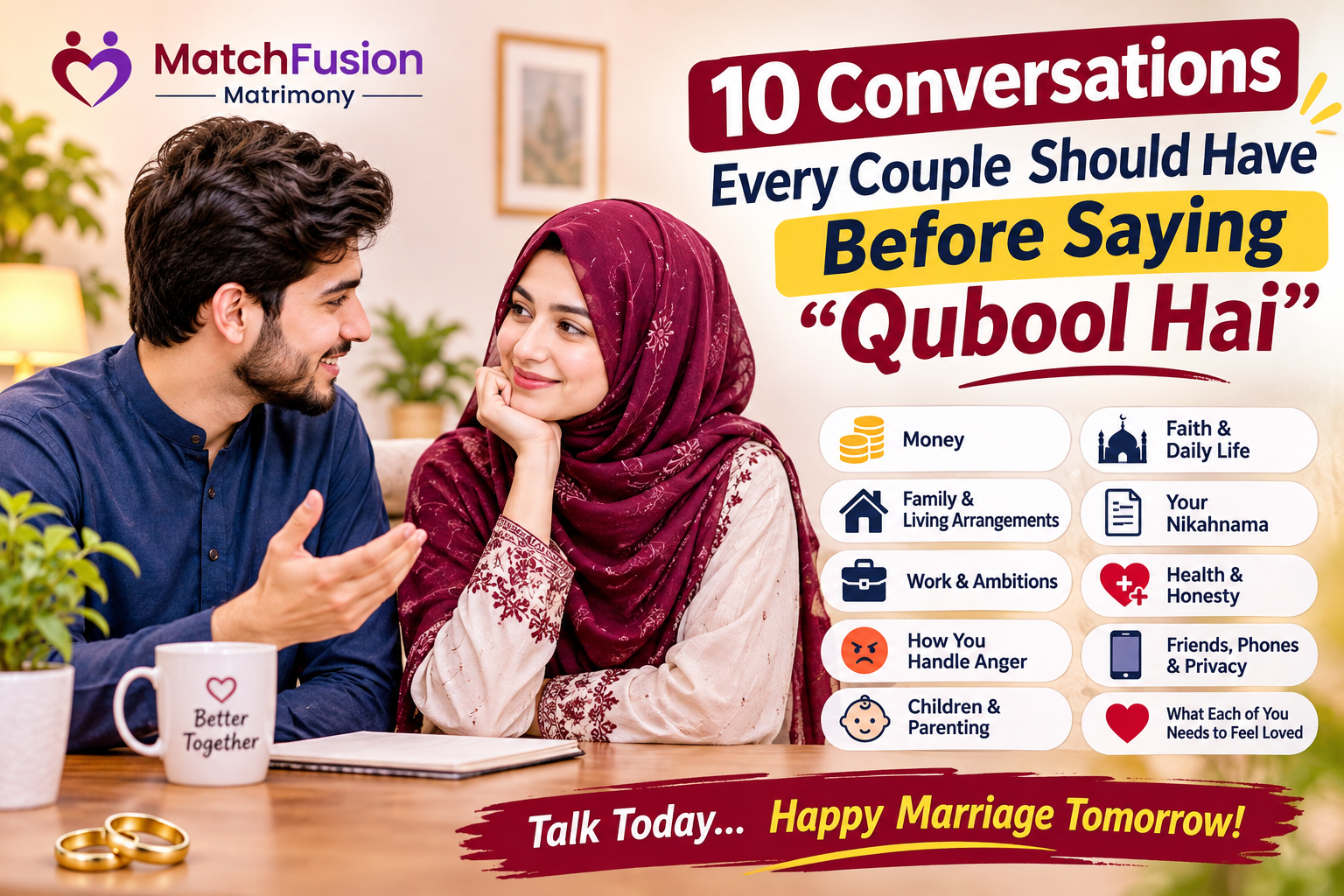
Explore ten essential topics couples should discuss before saying Qubool Hai.
A simple way to start
- You do not need to cover all ten talks in one evening. In fact, please don’t.
- Pick one topic per meeting, ideally with your families aware that you are getting to know each other.
- Start with “I” sentences, not “you” sentences.
- Listen first. You are collecting information, not winning an argument.
- Write down the big agreements, such as work and living arrangements, so memory does not bend them later.
- If the answers worry you, pause. A difficult conversation before marriage is far better than a difficult discovery after it.
- Consider a professional. A counsellor or a trusted, experienced elder can help both sides speak freely.
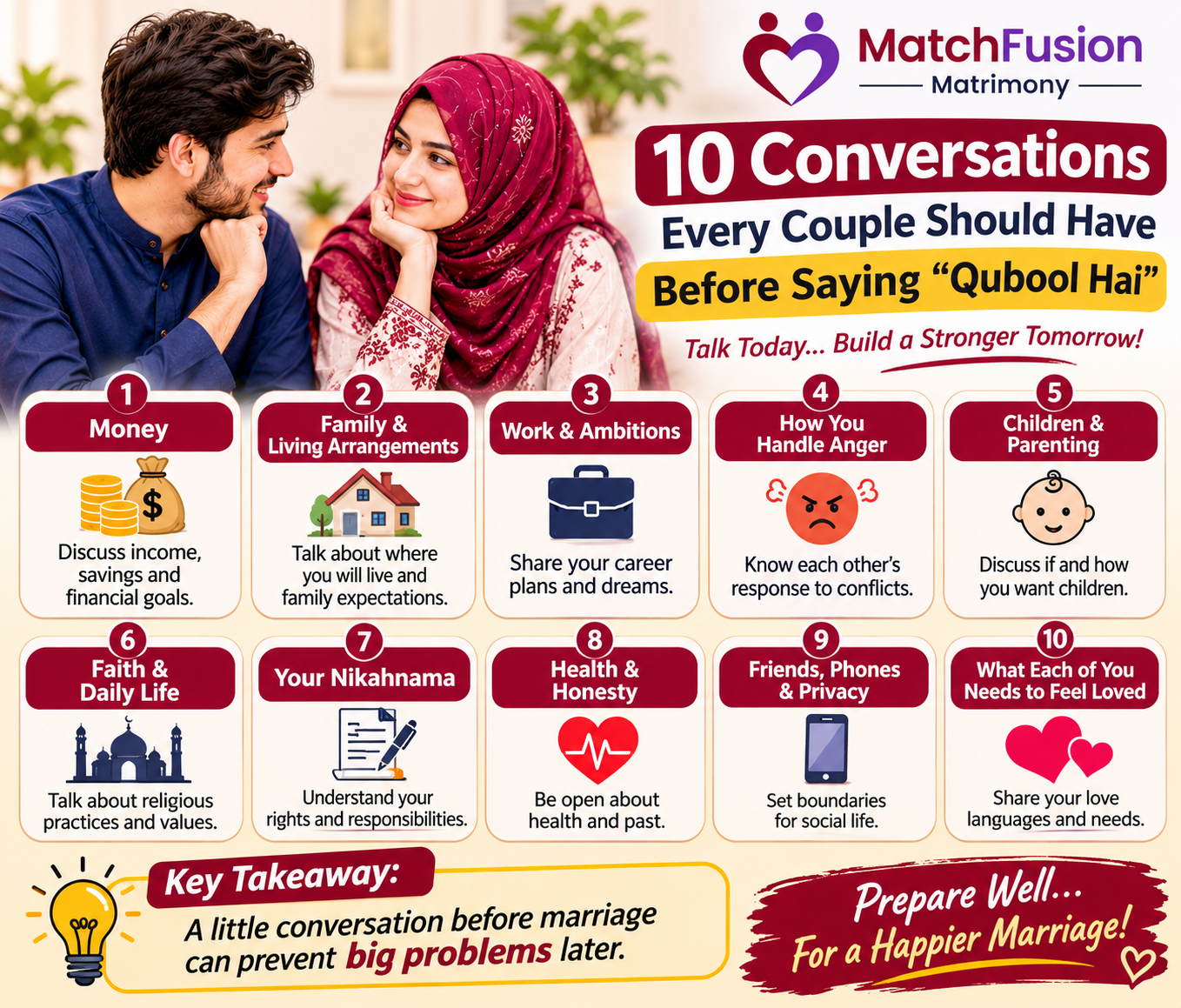
Strong marriages begin with understanding, honesty and meaningful conversations.
Ready to Start Your Rishta Journey?
MatchFusion Matrimony helps families in Faisalabad, across Pakistan and overseas discuss suitable proposals with privacy and family involvement.
Frequently asked questions
Is it rude to ask these questions during the rishta process?
Not if you ask respectfully and at the right stage. Once both families are seriously interested, a calm, polite conversation is a sign of maturity, not suspicion.
What if we disagree on something important?
Disagreement is normal. What matters is whether you can discuss it without contempt or silence. Research on couples suggests that how you handle conflict says more than whether you have it.
Does premarital counselling really work?
The evidence is encouraging but not absolute. Large surveys link it to higher satisfaction and lower divorce odds, while meta-analyses show modest average effects. Think of it as a helpful tool, not a guarantee.
Should the Nikahnama really be read in full?
Yes. It is a legal document, and the law expects every column to be filled in accurately. Read it, understand it, and ask questions before you sign.
Sources
- Stanley, S. M., Amato, P. R., Johnson, C. A., & Markman, H. J. (2006). “Premarital education, marital quality, and marital stability.” Journal of Family Psychology, 20(1), 117–126. PubMed record.
- Fawcett, E. B., Hawkins, A. J., Blanchard, V. L., & Carroll, J. S. (2010). “Do Premarital Education Programs Really Work? A Meta-Analytic Study.” Family Relations, 59(3), 232–239. Publisher record.
- Carrère, S., & Gottman, J. M. (1999). “Predicting Divorce among Newlyweds from the First Three Minutes of a Marital Conflict Discussion.” Family Process, 38(3), 293–301. DOI record.
- The Gottman Institute. “How to Fight Smarter: Soften Your Start-Up.”
- Supreme Court of Pakistan judgment coverage: “Supreme Court Orders Nikah Registrars to Fill All Nikahnama Columns Properly,” ProPakistani, 23 September 2026.
- “Dower is wife’s right, not a bargaining chip, SC rules,” Dawn, 23 September 2026.
- Muslim Family Laws Ordinance, 1961, and applicable rules. For legal decisions, consult the current official text and a qualified family lawyer.
Disclaimer: This article is for general information and does not replace legal, medical or counselling advice.